

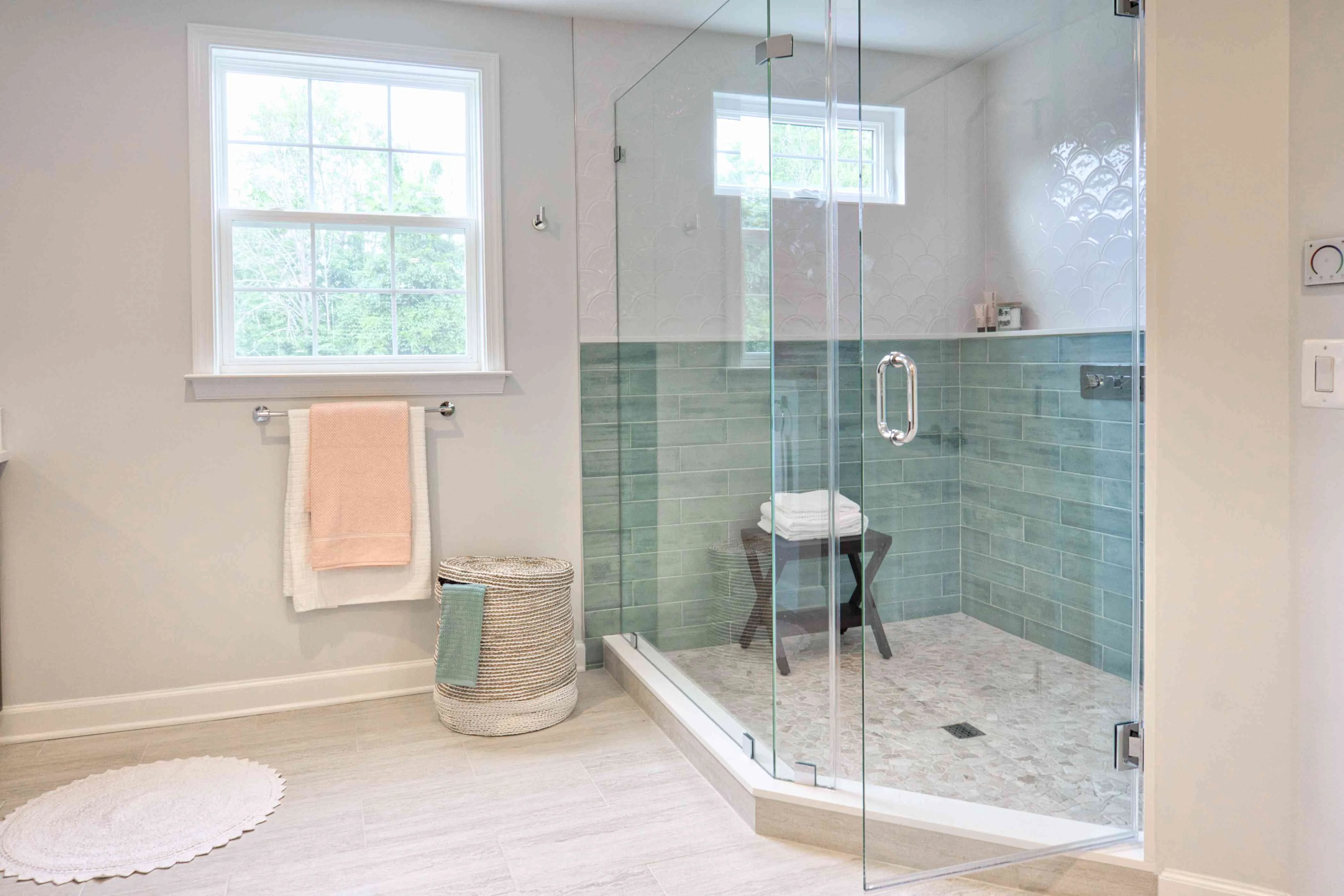

The door that looks better in photos is often the one that won’t actually fit your bathroom’s floor plan.
Choosing a shower door sounds simple until you actually have to fit one into a bathroom.
A hinged door may look elegant in a showroom, while a sliding door can seem more practical. But once you measure the bathroom, position the vanity, check the shower area and think about everyday cleaning, the decision can become much less obvious.
So when comparing sliding vs hinged shower doors, the best choice isn’t necessarily the one that looks better in a photograph. It is the one that works comfortably with the space you actually have.
In this guide, we’ll compare sliding and hinged shower doors based on space, appearance, maintenance, water control, accessibility, durability and cost, so you can make a more practical decision for your bathroom.
Sliding vs Hinged Shower Doors: Quick Comparison
| Feature | Sliding Shower Door | Hinged Shower Door |
|---|---|---|
| Space required | Low | Higher |
| Swing clearance | Not required | Required |
| Best for small bathrooms | Excellent | Depends on layout |
| Modern appearance | Yes | Yes |
| Cleaning | Track needs attention | Generally easier |
| Water sealing | Good | Generally very good |
| Hardware | Rollers and track | Hinges or pivots |
| Accessibility | Often easier | Depends on swing |
| Initial cost | Often lower | Often higher |
| Maintenance | Moderate | Generally lower |
The actual performance depends on the glass, hardware, enclosure design and installation quality.
What Is a Sliding Shower Door?
A sliding shower door moves horizontally along a track instead of swinging into the bathroom.
Depending on the design, one or more glass panels can slide behind another fixed panel.
This makes sliding doors particularly useful when there isn’t enough clear floor space for a conventional swinging door.
For apartments and compact bathrooms, this can be a major advantage.

What Is a Hinged Shower Door?
A hinged shower door opens by rotating around hinges or a pivot point.
It can swing outward, inward or be configured according to the shower enclosure and hardware design.
Hinged doors are popular in modern bathrooms because they provide a clean, open appearance, particularly when used with frameless or minimally framed glass.
However, they require enough space for the door’s swing.
Which Is Better for a Small Bathroom?
In most small bathrooms, sliding shower doors have the advantage.
The reason is straightforward: the door doesn’t need a swing arc.
A hinged door can require significant clearance in front of the shower. If the vanity, toilet, bathroom entrance or towel rail is nearby, the door can become awkward to operate.
A sliding door moves parallel to the wall, allowing you to use the available floor area more efficiently.
This is one reason sliding shower doors are particularly popular in compact Pune apartments.
When Does a Hinged Shower Door Make More Sense?
A hinged door can be a better option when you have sufficient clearance around the shower.
It can work especially well in:
- Larger bathrooms
- Walk-in showers
- Master bathrooms
- Hotel-style bathrooms
- Minimalist bathroom designs
- Frameless shower enclosures
If space isn’t a problem, the cleaner appearance and simpler operation of a hinged door can be attractive.
Structural Glazing vs Conventional Glazing: What Architects Should Know
Read this blog
Sliding Shower Doors: The Main Advantages
1. They Save Floor Space
This is the biggest advantage.
Because the door slides rather than swings, you don’t need to reserve floor space in front of the shower.
2. They Work Well in Compact Bathrooms
If your bathroom has a vanity or toilet close to the shower, sliding can make the layout much easier.
3. They Can Look Modern
A frameless or semi-frameless sliding enclosure can give a bathroom a clean contemporary appearance.
4. They Can Be Easier for Certain Users
There is no large swing arc to navigate around, which can be useful for elderly users or people with limited mobility.
5. They Offer Flexible Configurations
Sliding systems can be designed with different combinations of fixed and moving panels depending on the enclosure size.
The Disadvantages of Sliding Shower Doors
Sliding doors aren’t perfect.
The main issue is the track.
A bottom track can collect:
- Soap residue
- Hair
- Water
- Dust
- Mineral deposits
If it isn’t cleaned regularly, it can become difficult to maintain.
The rollers are another component that may eventually require attention.
A sliding door that starts feeling rough, noisy or difficult to move may have worn rollers or a dirty track.
What About Top-Hung Sliding Shower Doors?
A top-hung or top-track system moves the door from above rather than relying on a conventional bottom track.
This can reduce the amount of dirt and soap residue collecting at floor level.
It can also create a cleaner appearance.
However, the overhead fixing needs to be properly designed because the structure has to support the weight of the glass and hardware.
This is something that should be assessed during installation rather than treated as a simple hardware upgrade.
Hinged Shower Doors: The Main Advantages
1. Clean Appearance
A hinged glass door can create a simple, open appearance with fewer visible tracks.
This is one reason frameless hinged shower doors are popular in premium bathroom designs.
2. Easier Track Cleaning
Because there is no sliding track running along the floor, cleaning can be simpler.
You still need to clean the glass, seals and hinges, but there is generally less hardware at floor level.
3. Solid Operation
A well-installed hinged door can feel substantial when opening and closing.
Quality hinges and pivots are particularly important for frameless glass doors.
4. Good Water Control
With the correct seals, alignment and enclosure design, hinged doors can provide good control of water within the shower area.
However, the door design and shower layout still matter.
The Disadvantages of Hinged Shower Doors
The biggest limitation is space.
A hinged door needs room to swing.
Before selecting one, check whether the door could interfere with:
- Vanity
- Toilet
- Bathroom entrance
- Towel rail
- Shower fittings
- Other bathroom furniture
A beautiful hinged shower door isn’t very useful if you have to squeeze around it every morning.
Sliding vs Hinged Shower Doors: Which Is Easier to Maintain?
This is a close comparison.
Sliding Doors
Maintenance mainly involves:
- Cleaning the track
- Cleaning rollers
- Checking hardware
- Removing mineral deposits
- Keeping drainage areas clear
Hinged Doors
Maintenance generally involves:
- Cleaning the glass
- Checking hinges
- Inspecting seals
- Tightening or adjusting hardware when necessary
In general, hinged doors have fewer moving components, while sliding doors require more attention to their tracks and rollers.
However, a good-quality sliding system with proper installation can still provide reliable long-term performance.
Which Shower Door Is Easier to Clean?
For many homeowners, hinged doors are easier to clean because they don’t have a long bottom track.
Sliding doors can require additional attention around the track, particularly in areas with hard water.
A simple cleaning routine can help:
- Wipe the glass regularly
- Remove standing water
- Clean tracks and corners
- Remove soap buildup
- Check seals
- Keep drainage areas clean
Regular cleaning is much easier than trying to remove months of accumulated deposits.
Sliding vs Hinged Shower Doors: Which Is More Expensive?
There isn’t one fixed price because the final cost depends on the complete specification.
Factors include:
- Glass thickness
- Glass type
- Shower enclosure size
- Number of panels
- Frame or frameless design
- Hinges
- Rollers
- Track system
- Handles
- Installation
In general, a straightforward sliding system can be more economical than a premium frameless hinged system.
However, a high-end sliding system with specialised hardware can cost more than a basic hinged door.
So compare the complete specification, not simply the door style.
What Glass Should You Use for a Shower Door?
The glass specification is just as important as the door mechanism.
For shower enclosures, safety should be a priority.
Toughened safety glass is commonly considered for shower applications because of its strength and breakage characteristics.
Glass thickness should be selected based on the enclosure design, dimensions and hardware requirements.
If you’re comparing different glass options, Haimish’s article on toughened glass vs laminated glass can be linked here as a supporting resource.
Don’t choose glass thickness based solely on price.
Frameless vs Framed Shower Doors
The choice isn’t only between sliding and hinged.
You also need to decide whether the shower enclosure should be:
- Frameless
- Semi-frameless
- Framed
Frameless
Frameless shower doors provide a clean, premium appearance and use minimal visible framing.
They generally require carefully specified glass and hardware.
Semi-Frameless
Semi-frameless systems provide a balance between the clean look of frameless glass and the additional support of some framing.
Framed
Framed shower doors can provide a more traditional appearance and may offer practical advantages depending on the enclosure design.
The best choice depends on the bathroom design and budget.
A Real Bathroom Example: Why Measurements Matter
A good example is a bathroom in Bavdhan, Pune, where the homeowner initially wanted a frameless pivot-hinged shower door.
On paper, the hinged design looked perfect.
But once the bathroom was measured, there was a problem.
The door’s swing would have conflicted with the vanity and left very little clearance near the bathroom entrance. Swinging it inward wasn’t practical either because the shower area was compact.
A two-panel sliding configuration made much more sense for that particular space.
The lesson isn’t that sliding doors are always better.
It’s that the bathroom layout should decide the door—not the other way around.
What About Accessibility?
Accessibility is often overlooked when selecting bathroom doors.
For elderly family members or anyone with mobility limitations, a sliding door can be easier to operate because it doesn’t have a large swing arc.
A properly designed sliding enclosure can provide a clear entry without requiring the user to step around a swinging door.
For accessibility-focused renovations, the complete bathroom layout should be considered, including:
- Door opening width
- Shower entry
- Floor level
- Grab bars
- Handle position
- Water drainage
- Clear movement area
How to Choose Between Sliding and Hinged Shower Doors
Before making the decision, ask these questions.
1. How much space is available?
If floor space is limited, sliding is usually the safer choice.
2. Can a hinged door swing freely?
Measure the entire swing path, not just the shower opening.
3. How important is easy cleaning?
If you don’t want to clean a bottom track regularly, hinged or top-track sliding may be preferable.
4. What style do you want?
For a minimalist, hotel-style bathroom, a frameless hinged door can be particularly attractive.
5. Who will use the bathroom?
Consider children, elderly family members and anyone with mobility requirements.
6. What is your budget?
Compare the glass, hardware and installation—not just the door mechanism.
Sliding vs Hinged Shower Doors: Which One Should You Choose?
Choose Sliding Shower Doors If:
- Your bathroom is compact
- Floor space is limited
- A vanity is close to the shower
- You don’t have enough swing clearance
- You want an efficient layout
- Accessibility is important
Choose Hinged Shower Doors If:
- Your bathroom has sufficient space
- You prefer a minimalist look
- Easy track cleaning is important
- You want a frameless appearance
- The door can open without hitting other fixtures
Frequently Asked Questions
Are sliding or hinged shower doors better?
Neither is universally better. Sliding doors are generally better for compact bathrooms, while hinged doors can be ideal when there is enough clearance and you prefer a clean, minimalist appearance.
Which is better for a small bathroom?
Sliding shower doors are usually the better option because they don’t require floor space for the door to swing.
Are hinged shower doors easier to clean?
They can be. Without a conventional sliding track, there are fewer floor-level areas where soap and mineral deposits can accumulate.
Do sliding shower doors require more maintenance?
Generally, yes. Tracks and rollers need periodic cleaning and inspection. Top-track systems can reduce some of the maintenance associated with bottom tracks.
Are sliding shower doors cheaper than hinged doors?
Often, but not always. The final cost depends on the glass, hardware, dimensions, finish and installation.
What glass is best for shower doors?
Safety glass should be used for shower applications, with the appropriate type and thickness determined by the enclosure design and hardware requirements.
Can a hinged shower door open inward?
Some designs can be configured for inward opening, but the bathroom layout and safety requirements need to be considered carefully.
Can I use a sliding shower door in a very small bathroom?
Yes. Sliding doors are often particularly useful in compact bathrooms because they don’t require a swing area.
Final Verdict
When comparing sliding vs hinged shower doors, there isn’t a single winner.
A sliding shower door is usually the practical choice when space is tight. It can make a compact bathroom feel easier to use because the door doesn’t need a swing area.
A hinged shower door can be the better choice when space is available and you want a cleaner, more minimalist bathroom design with fewer moving components.
Ultimately, the best shower door is the one that fits your bathroom layout, glass specification, hardware requirements, maintenance expectations and budget.
And before choosing the style, measure the bathroom.
That one step can save you from buying a beautiful shower door that doesn’t work with the space.

