

Windows aren’t just openings in a wall anymore. In 2026, the aluminum window design you choose decides how your home feels, how much light you wake up to, and yes how much your electricity bill hurts every summer.
Over the past few years, homeowners in Pune and across India have quietly shifted away from old-school wooden or uPVC frames toward slim, modern aluminum windows. And it’s not just because aluminum looks better (though it does). There are very practical reasons this material has taken over new construction and renovation projects alike.
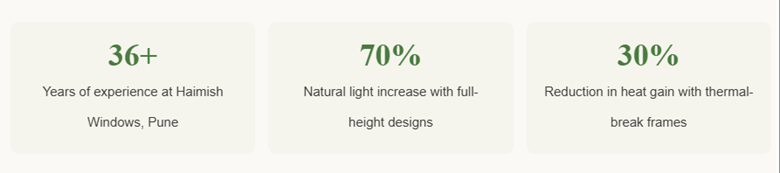
At Haimish Windows, we’ve been watching these shifts up close for 36 years. This piece covers exactly what’s moving in 2026 the designs, the practical benefits, and how the right window can genuinely change how you live inside your home.
Why aluminum window design is having a serious moment in 2026
Aluminum has always been strong. What changed is the design language around it. Slimmer sections, powder-coated finishes in 200+ colour options, and improved thermal performance have made it the go-to material for architects and interior designers working on everything from compact city apartments to large bungalows on the outskirts of Pune.
Compare that to wood beautiful, yes, but it warps in Pune’s monsoon humidity, requires annual upkeep, and ages poorly without constant care. uPVC is low maintenance but visually heavy and limited in span. Aluminum sits cleanly in the middle: strong enough to hold large glass panels with thin frames, virtually maintenance-free, and available in finishes that can mimic wood, matte metal, or any RAL colour your interior demands.
Material comparison at a glance
The 6 aluminum window design trends worth knowing in 2026
1. Slim-frame windows the one design change that transforms a room
Narrow-profile casement & fixed windows
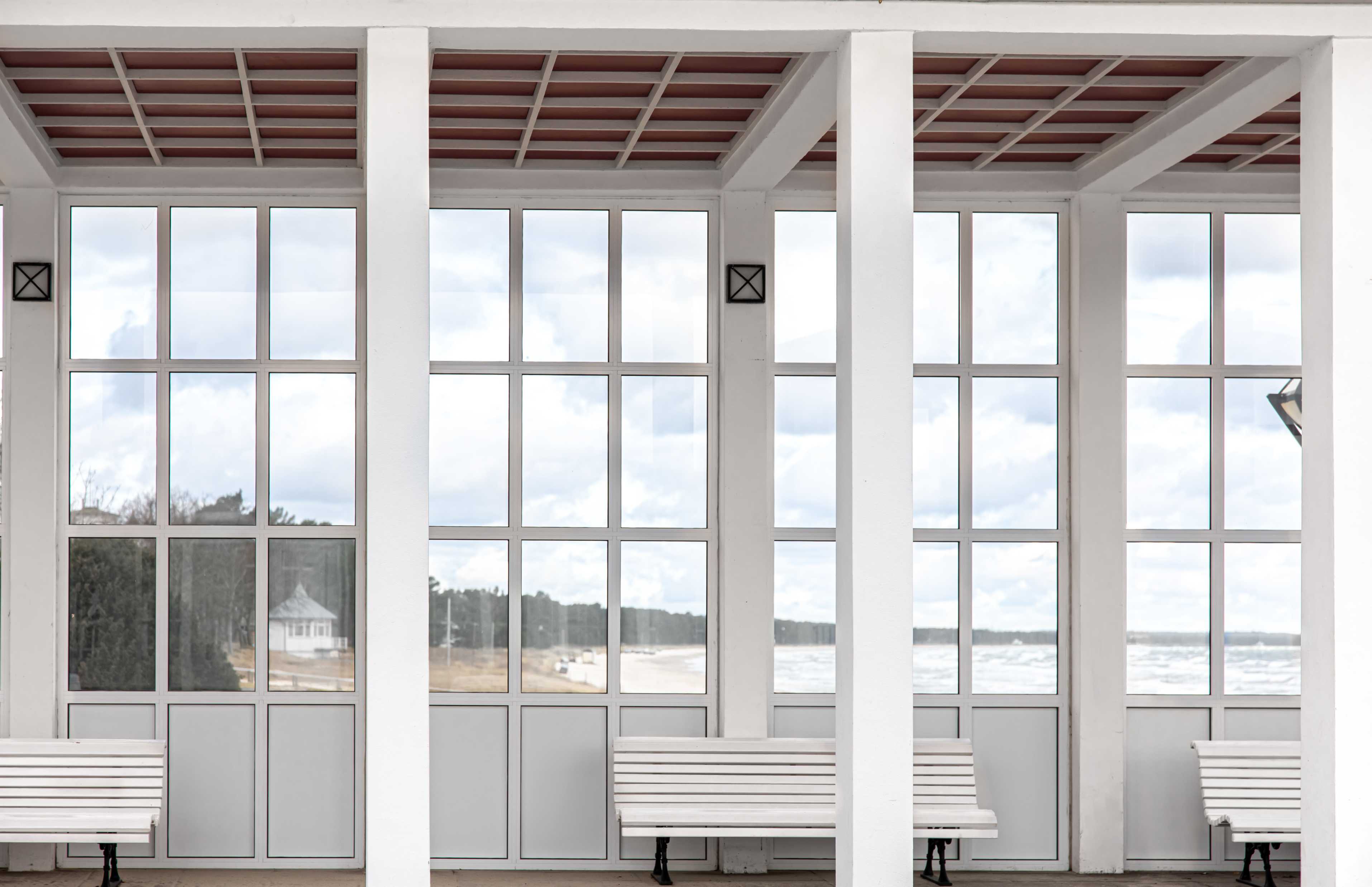
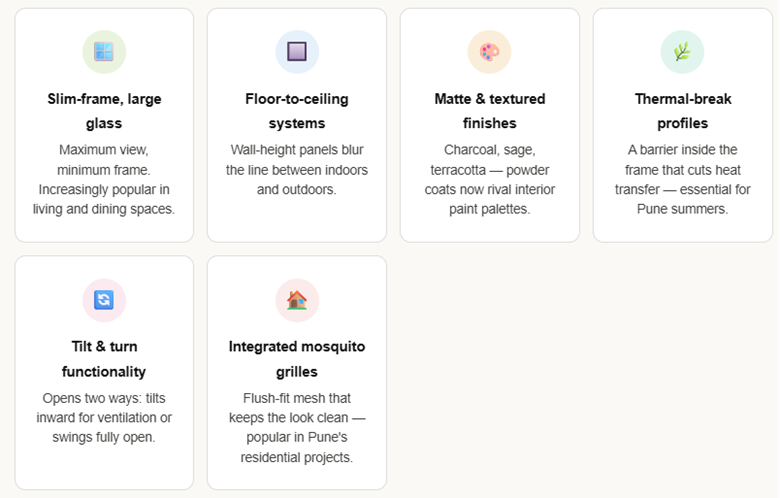
This is arguably the biggest shift of the last three years. Traditional aluminum sections had visible frames of 80–100mm. Modern slim-profile systems bring that down to 25–35mm. The difference in a room is dramatic you get significantly more glass area without touching the wall opening.
In living rooms, this means your garden, balcony, or city view becomes the focal point instead of the window frame. Interior designers have started treating slim-frame windows the way they’d treat a piece of large-format wall art positioning furniture to draw attention to them.
Practically, the slim profile is possible because of high-grade aluminum alloys (typically 6063 T5 or T6) that provide structural strength with less material. The glass does the work visually; the frame just holds it in place.
- More natural light enters the room without enlarging the wall opening
- Better views uninterrupted sightlines from interior to exterior
- Contemporary look that works across both modern and transitional home styles
- Structurally strong despite the slim appearance aluminum’s strength-to-weight ratio handles it well
2. Floor-to-ceiling aluminum windows when you want the outside to come in
Full-height fixed or sliding systems
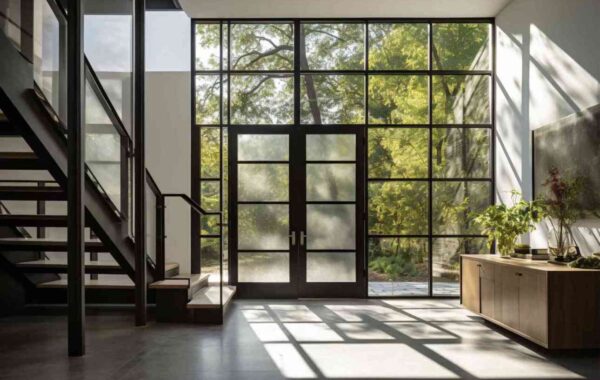
If you have a good view a garden, a valley, a city skyline floor-to-ceiling aluminum windows are how you make that view part of the room. These are large, wall-height panels that eliminate the visual cut-off you get with a traditional window sitting between a sill and a lintel.
In Pune’s newer residential projects, particularly in areas like Baner, Kharadi, and Wakad, floor-to-ceiling systems have become almost standard in living rooms and master bedrooms. Interior designers use them to create a sense of continuity between the interior space and the outdoor area especially effective on upper floors with landscape views.
The key structural requirement here is that the aluminum frame is designed to carry the weight of large glass panels sometimes double or triple glazed without deflection. This is where frame quality matters enormously. A poorly engineered large-span system will bow over time, affecting both aesthetics and weather sealing.
The right aluminum window doesn’t just let light in. It decides where your eye goes when you walk into the room.
Haimish Windows design team, Pune
3. Thermally-broken frames the trend that saves you money every month
Thermal-break aluminum profile systems
Pune summers are brutal. If your air conditioning seems to run non-stop, your windows could be a big part of the problem. Standard aluminum conducts heat efficiently which sounds like a feature but isn’t, because in summer, that means your frame is actively transferring outdoor heat into your cooled room.
Thermal-break profiles solve this with a polyamide strip inserted between the inner and outer aluminum sections of the frame. This strip acts as a barrier that significantly reduces heat transfer. The difference in room temperature retention is real and measurable typically a 25–30% reduction in heat gain through the window assembly.
In 2026, thermally-broken frames have moved from a premium add-on to a mainstream choice, particularly in double-glazed configurations. They also reduce condensation on the inner glass surface relevant in Pune’s monsoon months when temperature differences between inside and outside can be significant.
4. Tilt & turn windows European engineering that makes sense in 
Dual-action tilt & turn hardware
A tilt & turn window operates two ways from a single handle rotation. Turn the handle horizontally: the window swings fully open on a vertical axis like a door. Turn it upward: the top of the window tilts inward 10–15 degrees for controlled ventilation.
The ventilation position is particularly useful during Pune’s monsoon you get airflow without rain driving directly into the room. The tilt also acts as a passive safety feature, since a tilted window cannot be opened wide enough for a child to fall through.
From a cleaning perspective, tilt & turn is genuinely practical in apartment living both glass faces are accessible from inside, which matters when you’re on the 8th floor with no external access to the outer glass.
4. Tilt & turn windows European engineering that makes sense in Indian homes
Dual-action tilt & turn hardware
A tilt & turn window operates two ways from a single handle rotation. Turn the handle horizontally: the window swings fully open on a vertical axis like a door. Turn it upward: the top of the window tilts inward 10–15 degrees for controlled ventilation.
The ventilation position is particularly useful during Pune’s monsoon you get airflow without rain driving directly into the room. The tilt also acts as a passive safety feature, since a tilted window cannot be opened wide enough for a child to fall through.
From a cleaning perspective, tilt & turn is genuinely practical in apartment living both glass faces are accessible from inside, which matters when you’re on the 8th floor with no external access to the outer glass.
5. Custom powder-coat finishes because your windows should match the rest of the house
RAL color-matched powder coatings
Aluminum’s powder-coating capability has matured significantly. In 2026, you’re not choosing between white, brown, or silver. You’re picking from a full RAL palette the same colour matching system used for exterior paints, automotive finishes, and interior furniture.
Homes in Pune are increasingly using window frames as an intentional part of the exterior palette. Dark charcoal frames against a white or off-white facade. Warm terracotta on a contemporary brick exterior. Forest green on a home with garden-facing windows. The frame colour does visual work that most homeowners previously left to the walls alone.
The practical side: properly applied powder coatings are UV-stable, scratch-resistant, and unaffected by Pune’s combination of heat, monsoon humidity, and airborne dust. A quality powder-coated finish should hold colour for 20+ years without repainting.
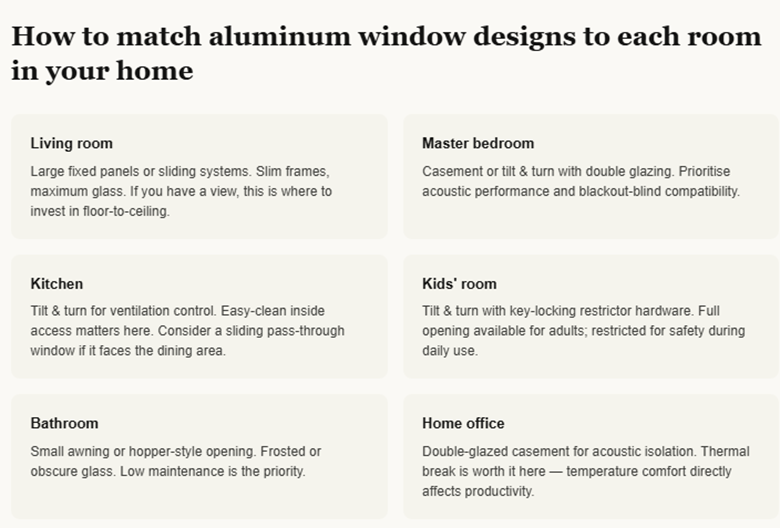
What to ask before buying aluminum windows a practical checklist
Most homeowners don’t know what to ask, which means they often end up with the wrong specification. Before you commit to any aluminum window system, here are the questions worth raising with your manufacturer or contractor:
- What aluminum alloy grade are the profiles made from? (6063 T5 or T6 are the benchmarks for structural performance)
- Is the frame a thermal break or standard construction? (For living spaces in Pune, thermal break is worth the premium)
- What is the powder-coating thickness and which standards does it meet? (Minimum 60 microns for good UV resistance)
- What hardware brand is used for the fittings? (Cheaper hardware fails faster than the frame it’s a false economy)